

Why Discipline Protects Us from Emotion
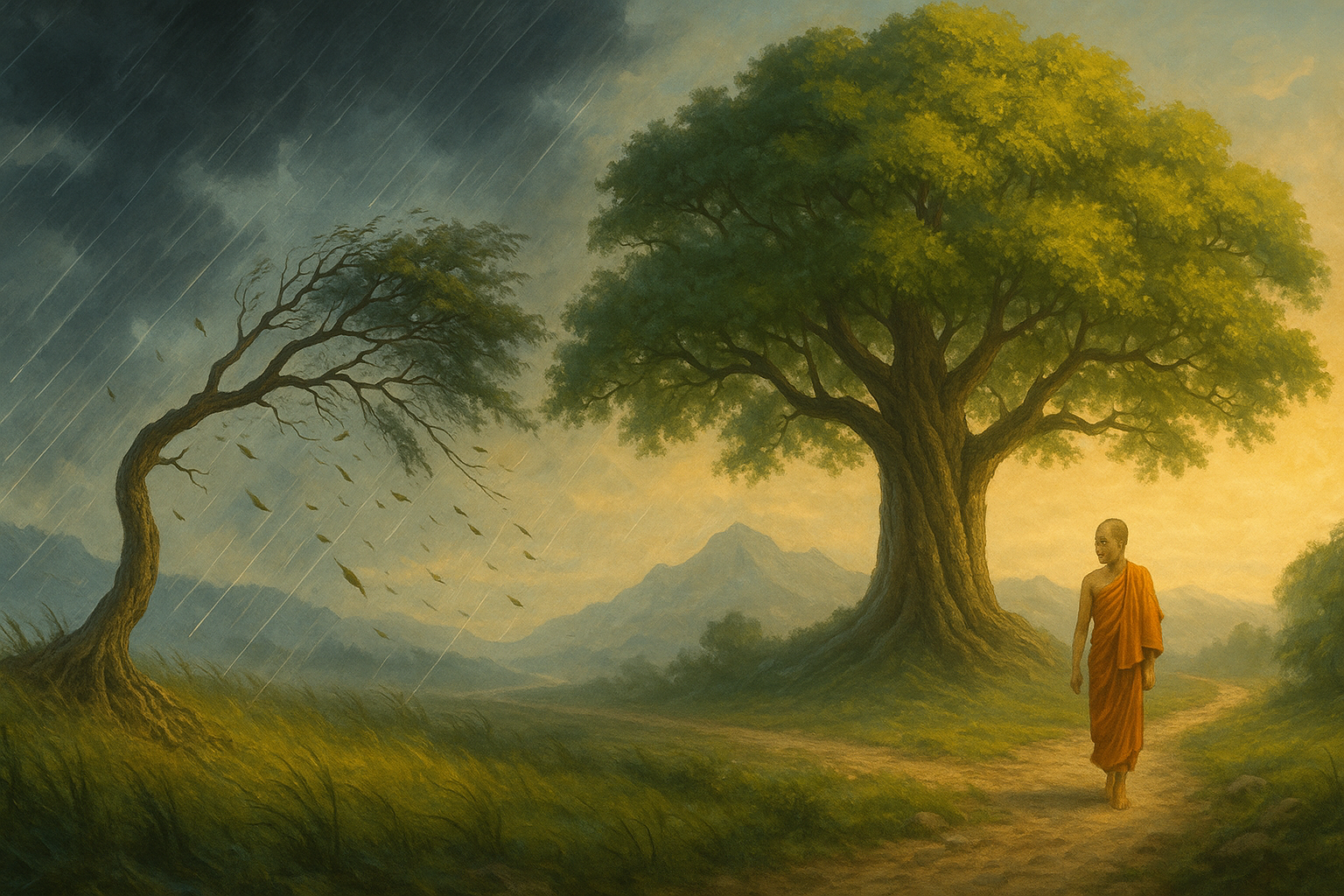
The Buddha once said:
“One who dwells on beauty, lives unguarded, eats without restraint, and is lazy and undisciplined—
that one Māra overthrows, like wind topples a weak tree.”
— Dhammapada – Yamaka Vagga – Verse 7
But…
“One who contemplates decay, guards the senses, eats mindfully, has faith and energy—
that one Māra cannot shake, like wind cannot move a rocky mountain.”
— Dhammapada – Yamaka Vagga – Verse 8
These two verses aren’t just poetic metaphors—they offer us a practical way to measure our own inner strength.
Are we like a weak tree, swaying in the storms of temptation and emotion?
Or are we like a mountain, grounded in mindfulness and self-discipline?
The Story of Monk Mahākāla
Mahākāla wasn’t always a monk.
He and his brother Cūlakāla were merchants who ran a caravan of 500 carts. One evening, while resting near the city of Sāvatthi, Mahākāla saw crowds heading toward the monastery. Curious, he followed—and sat to listen to the Buddha.
That night, the Buddha spoke about the dangers of sensual pleasures, the trap of attachment, and the suffering that follows desire. Something in Mahākāla shifted. He renounced his former life and became a monk.
His brother Cūlakāla followed—but with hesitation. His heart still clung to the world.
A Lesson from the Burning Ground
Mahākāla asked the Buddha:
“I am old. I may not be able to study deeply. Can I focus only on contemplation?”
The Buddha guided him to cemetery meditation, where monks reflect on death and impermanence.
One night, a young woman suddenly died and was brought to the burning ground. The keeper, seeing her beautiful body, thought it would be a suitable meditation subject for the monk. When Mahākāla examined her corpse, and later, watched it burn, he saw—viscerally—how fragile beauty is.
He reflected:
“This body, which just yesterday caused people to forget the Dhamma, is now breaking down. Death has come.”
That night, Mahākāla attained Arahatship, complete spiritual awakening.
Strength Is in Restraint
Mahākāla practiced:
- Restraint of the senses
- Moderation in eating
- Contemplation on decay and death
- Faith and effort
He wasn’t distracted by pleasure or laziness. He became, as the Buddha described, like a mountain unmoved by storms.
Contrast: His Brother Cūlakāla
Cūlakāla, still entangled with his past life, visited his former home. His wives, hoping to bring him back, tore off his robes. He left monastic life.
Mahākāla’s wives tried the same. But when they tried to manipulate him, he rose into the air—literally—using his psychic powers as an Arahat. He returned to the Buddha, who praised him as unshakable.
Reflection: Becoming Like a Mountain
Modern life is full of wind—temptation, distraction, comparison, resentment.
We can:
- Chase pleasure and numbness (and be toppled),
- Or practice restraint, mindfulness, and effort—and become grounded.
This doesn’t mean we hate beauty or avoid joy. It means we see clearly, without clinging. We live responsibly. We cultivate inner strength.
Māra, the personification of delusion, cannot conquer the one who trains like this.
A Thought for the Day
Are your roots deep enough to hold you steady?
When storms come—disappointment, temptation, anger—do you sway… or do you stay?